Unlike Circuit 2's 2A and 2B — which mostly differ by viewpoint angle on the same walk — Circuit 3A and 3B differ by something much bigger: a mountain. Both routes walk the same "Royalty" sector, including the Temple of the Sun, the Royal Palace and the genuinely remarkable Temple of the Condor. 3A then adds the full climb to the Huayna Picchu summit on top of that walk. 3B doesn't climb anything at all. That's the real difference, and it matters a lot more for planning your trip than any photo angle does.
Why This Comparison Isn't Like Circuit 2A vs 2B
If you've read our Circuit 2A vs 2B guide, don't assume the same logic applies here — it doesn't. On Circuit 2, 2A and 2B walk almost the same ground and differ mainly by whether an elevated viewpoint is included. On Circuit 3, the difference is structural: 3B is the complete "Royalty" walk on its own, and 3A is that same walk plus an entirely separate, multi-hour mountain ascent. This is much closer in shape to the difference between Circuit 1A and 1B — a base route plus an optional summit — than to anything on Circuit 2.
Route 3A — Royalty Walk + Huayna Picchu
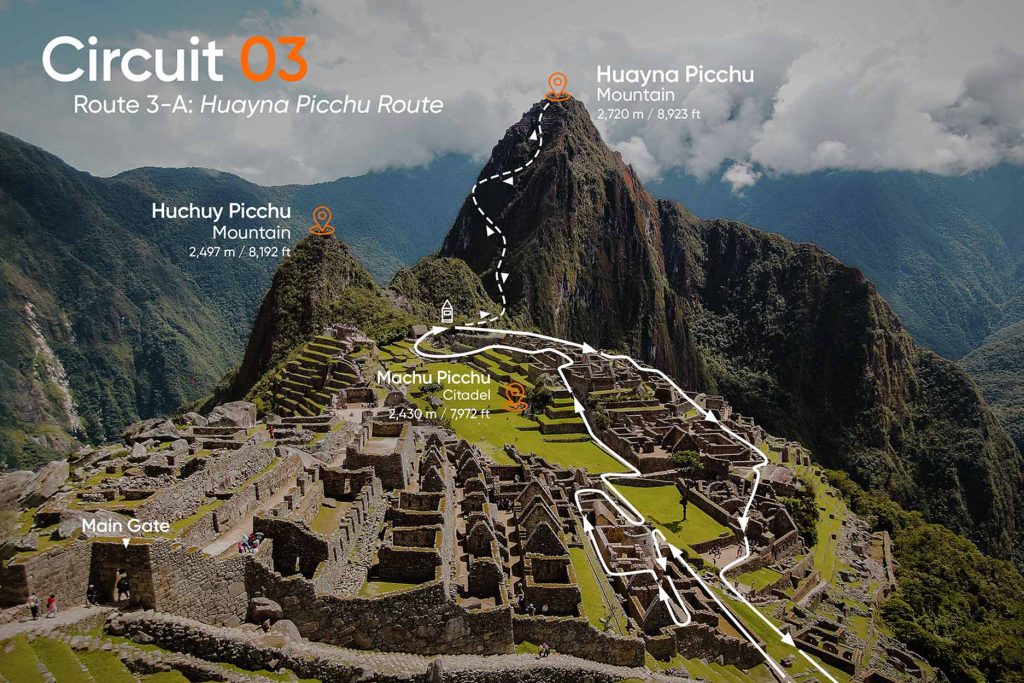
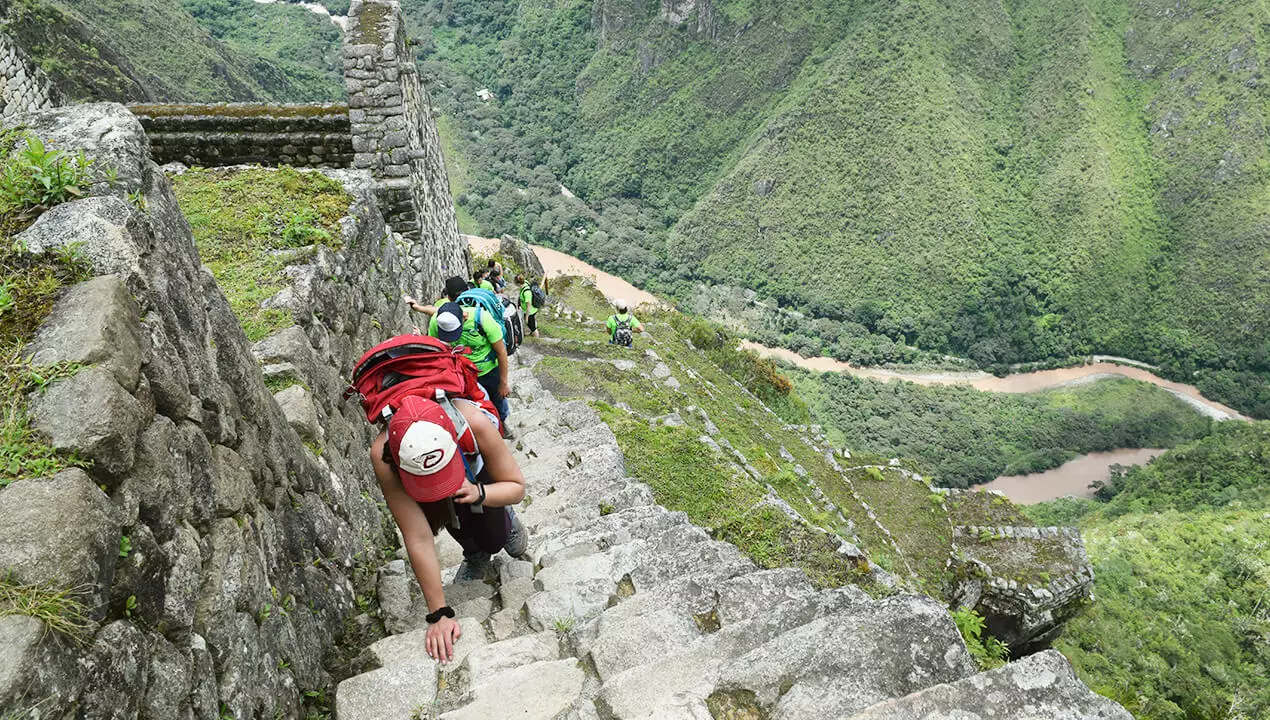
Huayna Picchu ("Young Peak," a deliberate naming contrast to Machu Picchu, "Old Peak") rises directly behind the citadel in nearly every classic photograph. Its summit sits at approximately 2,693m — a gain of roughly 300m (984 ft) from the citadel, climbed via more than 1,600 stone steps on narrow Inca stairways. The route covers about 2.4km round trip and takes up to 6 hours total, including ascent, time at the summit, and descent, depending on fitness level. The climb itself typically runs closer to 3 hours; the remainder is the Royalty-sector walk shared with 3B.
What makes it unique: the closest, most vertiginous aerial view of the citadel available anywhere at Machu Picchu. Practical detail: entry is limited to two daily windows — 7:00 AM and 10:00 AM — with daily capacity capped at roughly 350 visitors; this is consistently one of the first Machu Picchu ticket types to sell out each season. Note that these times mark entry to the mountain itself, not the main citadel gate — arrive at least an hour ahead, since you'll walk part of the Royalty sector before beginning the ascent. Who should think twice: anyone with significant vertigo — handrails exist, but the exposure is real, and there's no early exit besides continuing or turning back the way you came.

Route 3B — The Royalty Walk, No Climb
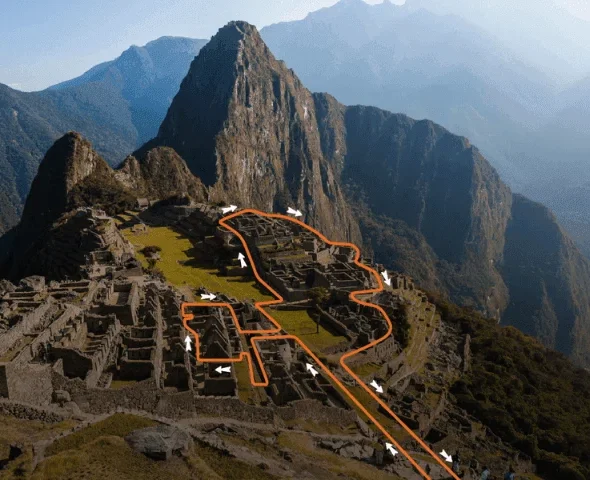
3B is the same Royalty-sector walk without any mountain add-on: a flat, roughly 1.3km route through the Temple of the Sun, Royal Palace, Temple of the Condor, Sacred Rock and the fountain system, taking up to 2 hours 30 minutes at a relaxed, level pace. What makes it unique: it's the only Circuit 3 sub-route open across ten separate daily entry windows, from 6:00 AM to 3:00 PM — by far the most scheduling flexibility of any route on this circuit, and suitable for all ages and most physical conditions, including many visitors with disabilities (with assistance). Best for: travellers with limited mobility, families with young children, or anyone visiting on short notice when Huayna Picchu is already booked solid.
What Both Routes Share — In Scholarly Depth
Whichever route you take, this is the walk you're actually doing — and it's more than a checklist of ruins.
Temple of the Sun (Torreón)
The only curved-wall structure at Machu Picchu, raised on a natural granite outcrop. Hiram Bingham, following his 1911 Yale-sponsored expedition, named it for its resemblance to the Coricancha, Cusco's own Temple of the Sun. Its trapezoidal windows align to the June and December solstices, and a cave beneath it — labelled the Royal Mausoleum (or Royal Tomb) by Bingham — is thought to have housed members of the Inca elite, possibly including priests or the Inca himself; carvings on its walls are linked to Pachamama, Mother Earth, and the debate between a burial function and a purely ceremonial one remains unresolved.

Royal Palace
Attributed to Pachacuti, arranged in the classic Inca "kancha" layout of enclosures around a courtyard. It contains the only water-flushed lavatory documented at the site and a private stone-cut bathing pool fed directly from the spring system — meaning its resident received the citadel's freshest water before it reached any other household.
Temple of the Condor
Found in the "Hurin" (lower) neighbourhood of the urban sector, the Temple of the Condor is one of the most striking pieces of natural- rock integration anywhere at Machu Picchu: two vertical rock formations shaped to resemble outstretched wings, with a carved stone on the ground completing the figure as the bird's head and neck feathers — a condor in the moment of landing. In Inca cosmology the condor represented Hanan Pacha, the celestial realm, one of three sacred animals alongside the puma (the earthly world) and the serpent (the underworld).
Archaeologists have recovered ceramics, textiles and organic remains from a stone altar formed by the condor's "head," and a small cave beneath the wings once held a mummy — findings that support ceremonial and possibly funerary use. Directly behind the temple, a complex of human-sized niches and connected underground chambers is widely interpreted as a prison, leading some researchers to link the site to ritual sacrifice as well as condor worship, though the exact nature of what took place there is still debated rather than settled fact.

Sacred Rock & the Fountains
The same granite monolith whose silhouette mirrors Yanantin mountain behind it — documented by archaeologists as an example of Inca "landscape imitation" — sits alongside a descending system of stone fountains fed by the site's spring, another example of how Machu Picchu's engineering served both the ceremonial and the practical sides of daily life.
The Complete Side-by-Side Comparison
| Feature | Route 3A | Route 3B |
|---|---|---|
| Temple of the Sun, Royal Palace, Temple of the Condor, Sacred Rock | Included | Included |
| Huayna Picchu climb | Included (~2,693m summit) | Not included |
| Distance | ~2.4 km round trip | ~1.3 km round trip |
| Elevation gain | ~300m (984 ft) | Minimal — flat route |
| Typical duration | Up to 6 hours total | Up to 2 hours 30 minutes |
| Entry windows | 2 per day — 7:00 AM & 10:00 AM | 10 per day — 6:00 AM to 3:00 PM |
| Daily capacity | ~350 visitors | Ample — highest of any Circuit 3 route |
| Physical demand | High — steep, exposed stairways | Low — flat, well-maintained paths |
| Sell-out speed | Very fast — often the first ticket gone in high season | Wide availability year-round |
| Best for | Fit hikers comfortable with height and exposure | Everyone else — families, limited time, or 3A sold out |
Which Should You Choose? By Traveler Type
Fit hikers chasing the dramatic aerial view
Choose 3A. Nothing else at Machu Picchu gives you that specific close, vertiginous angle over the citadel. Book 2–3 months ahead in high season — this sells out fast.
Anyone with vertigo or discomfort with exposure
Choose 3B. The Huayna Picchu trail includes genuinely narrow, steep sections — if heights aren't your thing, the Royalty walk alone is the better call, not a lesser one.
Families with children or older travelers
Choose 3B. The flat, well-maintained path covers the same archaeology without the multi-hour physical commitment of the climb, and it's explicitly positioned as accessible for visitors with disabilities, provided they travel with assistance.
History and archaeology-focused travelers
Either works — the Temple of the Condor, Royal Palace and Torreón are identical on both tickets. Choose 3B if the climb itself doesn't add anything to your specific interest in the site's history.
Travelers booking last-minute
Choose 3B — with ten entry windows spread across the day, it is by far the easier of the two to find availability for on short notice.
Best Time to Visit
The dry season (May–October), especially May, June and September, offers the clearest skies and most comfortable walking conditions for either route. The wet season (November–April) brings fewer crowds and better prices, at the cost of more rainfall and occasionally slippery stone steps on the 3A ascent.
| Feature | Dry Season (May–Oct) | Wet Season (Nov–Apr) |
|---|---|---|
| Weather | 18–25°C, sunny days | Warm days, 7–12°C at night, regular rain |
| Daily visitor cap | Up to 5,600/day (high-season dates) | Up to 4,500/day |
| Ticket availability | Sells out fast — book 2+ months ahead | Easier to find last-minute dates |
| Landscape | Clear panoramic views | Misty, greener, more atmospheric |
| Prices (hotels/tours) | Highest of the year | Best deals and promotions |
Ticket prices themselves don't change between seasons — only availability and the surrounding cost of hotels, trains and tours do.
Getting There: The Same Journey, Either Route

Both 3A and 3B are reached identically — the route choice only matters once you're inside the citadel.
Cusco → Ollantaytambo
Private or shared van, approximately 1 hour 30 minutes by road through the Sacred Valley.
Ollantaytambo → Aguas Calientes
PeruRail train, approximately 1 hour 40 minutes, following the Urubamba River through cloud forest.
Aguas Calientes → Machu Picchu
Consettur tourist bus — the sole authorized operator — takes 25–30 minutes, departing every 5–10 minutes from 5:30 AM. A marked hiking alternative from Puente Ruinas also exists: roughly 8km with 400m of elevation gain, taking 1.5–2 hours.
Because 3A's entry windows are both in the morning and the day involves up to 6 hours inside the sanctuary, an overnight stay in Aguas Calientes is strongly preferable to a same-day train for that route. 3B's flatter, shorter visit — with entry windows running all the way to 3 PM — is far more flexible to fit into a single long day from Cusco. Bags are limited to 40 x 35 x 20cm, single-use plastics are prohibited at entry, and re-entry is not permitted once you exit.
Book Your Circuit 3 Experience

- For travelers who want 3A's summit ambition without a same-day rush
- 4 days of trekking through the Salkantay range before Machu Picchu
- Climbs Machu Picchu Mountain rather than Huayna Picchu — a genuine alternative summit
- No permit competition with Huayna Picchu's fast-selling allocation
- Best fit if you're choosing 3B — no mountain climb required
- Round-trip PeruRail journey through the Sacred Valley
- Guided walk through the Royalty sector with a local Quechua guide
- Back in Cusco the same evening — no overnight needed
Climbing 3A, or considering the multi-day Salkantay approach instead? Choosing the flatter 3B? Either way, tell our team when you book and we'll match the right departure to your route.
Tickets, Official Pricing & Booking Notes
3A carries a meaningfully higher price tier than 3B, reflecting its separate, capped mountain-access allocation. Prices below reflect 2026 official rates set by Peru's Ministry of Culture; always confirm current figures against our full Machu Picchu Tickets guide before booking, since rates are periodically revised.
Route 3A — Huayna Picchu (2026 official rates)
| Category | Foreign | Peruvian | CAN / Foreign resident | Cusco citizen |
|---|---|---|---|---|
| General | S/200 | S/112 | S/112 | S/112 |
| Undergraduate student | S/125 | S/80 | S/80 | S/80 |
| Minor (3–17) | S/118 | S/80 | S/80 | S/80 |
| Under 3 | Free | Free | Free | Free |
Route 3B — Designed Royalty (2026 official rates)
| Category | Foreign | Peruvian | CAN / Foreign resident | Cusco citizen |
|---|---|---|---|---|
| General | S/152 | S/64 | S/64 | S/64 |
| Undergraduate student | S/77 | S/32 | S/32 | S/32 |
| Minor (3–17) | S/70 | S/32 | S/32 | S/32 |
| Under 3 | Free | Free | Free | Free |
Undergraduate students must present a valid university ID, issued in their home country, at both purchase and entry. CAN discounts apply to citizens of Bolivia, Colombia and Ecuador as members of the Andean Community of Nations.
Age guidance for 3A: official sources themselves report this inconsistently — some state 12+, others 18+ — confirm current requirements with your operator before booking. Guide: mandatory for citadel entry on either route, per Ministerial Resolution No. 000285-2025-MC.
Myth vs. Fact
- ✓ 3A and 3B differ by viewpoint angle, like Circuit 2A vs 2B.
- ✓ 3B is a stripped-down, lesser version of the Royalty tour.
- ✓ The Temple of the Condor is a minor stop, not worth planning around.
- ✓ The difference is a mountain climb, not a photo angle — structurally like 1A vs 1B.
- ✓ 3B walks the exact same Royalty sector as 3A, minus the climb.
- ✓ The Temple of the Condor has a documented ritual, possibly funerary, and prison-complex history — one of the most archaeologically rich stops on either route.
Glossary
Hanan Pacha: The celestial realm in Andean cosmology, represented by the condor.
Kancha: An Inca architectural unit of enclosures around a central courtyard, used for the Royal Palace.
Torreón: Spanish for "tower" — the common name for the Temple of the Sun, shared by both routes.
Boleto: Spanish for "ticket," as in tuboleto.cultura.pe, the official government booking platform.
Common Mistakes
Applying the 2A/2B logic here. This is a mountain decision, not a photo-angle decision. Underestimating Huayna Picchu's exposure. The trail is genuinely narrow and steep in places — confirm your comfort with heights honestly before booking 3A. Assuming 3B skips major stops. It doesn't — the Temple of the Condor, Royal Palace and Torreón are all included. Assuming ticket prices change by season. They don't — only availability and surrounding travel costs do. Planning to enter without a guide. Citadel entry now requires a licensed guide's group on either route.
International Recognition
Machu Picchu has been a UNESCO World Heritage Site since 1983 and was voted one of the New Seven Wonders of the World in 2007. The Temple of the Condor is regularly cited in popular and academic writing on Inca stone-and-landscape integration as one of the clearest examples anywhere in the Andes of natural rock deliberately worked into ceremonial sculpture.
Frequently Asked Questions — Circuit 3A vs 3B
Circuit 3A and 3B aren't a subtle choice between two similar experiences — they're a real fork between a demanding mountain climb and a flat walk through the same rich history either way. Decide honestly based on your fitness and comfort with heights, not on the assumption that one route is somehow the "full" version and the other a shortcut. The Temple of the Condor alone is worth the trip regardless of which ticket gets you there.
We'll book the right one.


