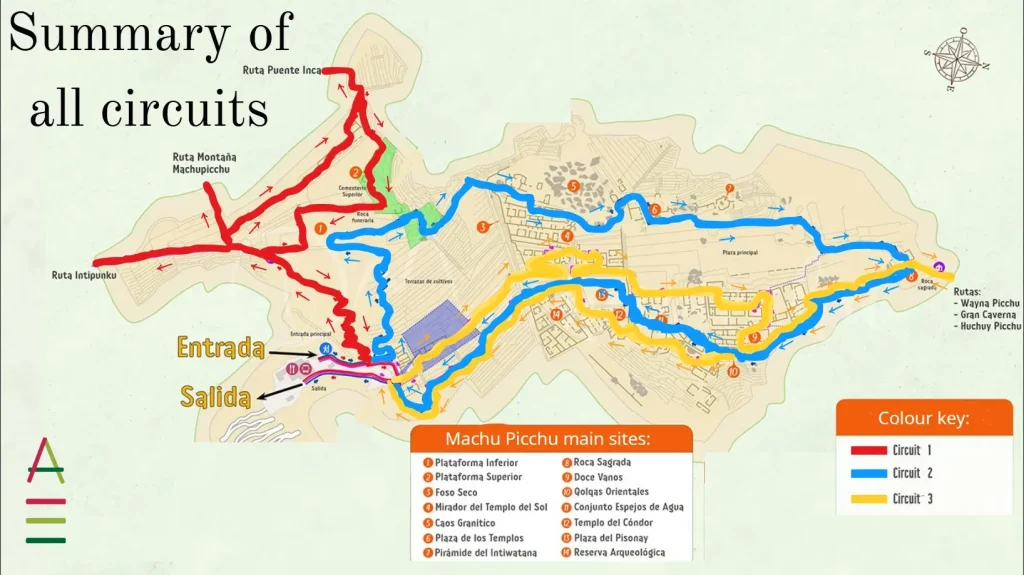
Short answer: Circuit 3A is one of the two path sequencings within Circuit 3 — and the one that includes the climb up Huayna Picchu. It covers the same lower-terrace ground as Circuit 3B, then adds the out-and-back hike up the emblematic Huayna Picchu peak, which on its own takes roughly 2 to 3 hours.
What Circuit 3A Actually Involves
Circuit 3A follows the same lower-terrace path and viewpoint sequence as Circuit 3B. The key difference is that 3A also includes the climb up Huayna Picchu — a steep, narrow, cable-assisted trail with real exposure in places. That makes 3A a good fit for travelers who specifically want the mountain climb and the panoramic views it offers, and a poor fit for anyone looking for a light, low-effort visit.
Huayna Picchu: The Mountain Behind the Postcard
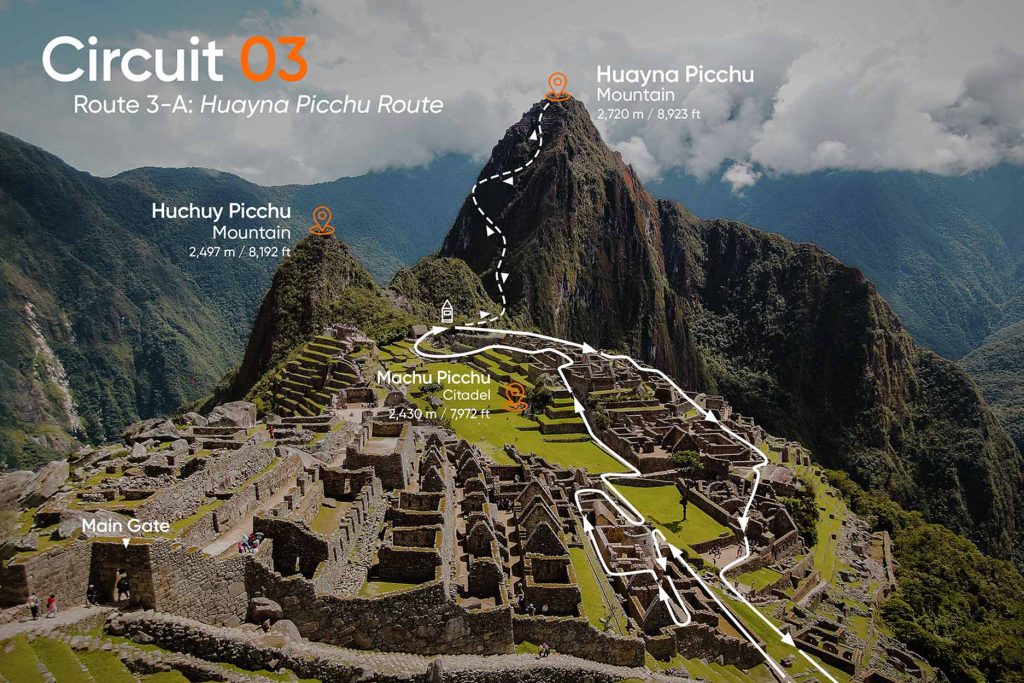
Huayna Picchu — "Young Mountain" in Quechua, as opposed to Machu Picchu, "Old Mountain" — is the sharp, cone-shaped peak that rises directly behind the citadel in almost every classic photo of the site. It sits about 2 km north of the main ruins, wrapped on three sides by a bend in the Urubamba River, and tops out at roughly 2,690-2,720 meters (8,830-8,920 ft) above sea level — around 300 to 350 meters higher than Machu Picchu itself. The Incas built a stone stairway up its flank along with small terraces and structures near the summit; local tradition holds that a high priest and a small group of attendants lived up there, descending each morning to signal the arrival of a new day to the citadel below.
Partway down the far side of the mountain, below the main summit trail, sits the Temple of the Moon and the adjoining Great Cavern — a quieter, less-visited detour with some of the finest stonework on the whole site. It's a genuinely worthwhile stop, but it adds significant extra time and a steep, sometimes muddy detour trail, so it's usually treated as its own separate add-on rather than part of a standard Circuit 3A visit. Ask our team if you'd like it built into your day.

How Hard Is the Huayna Picchu Climb?
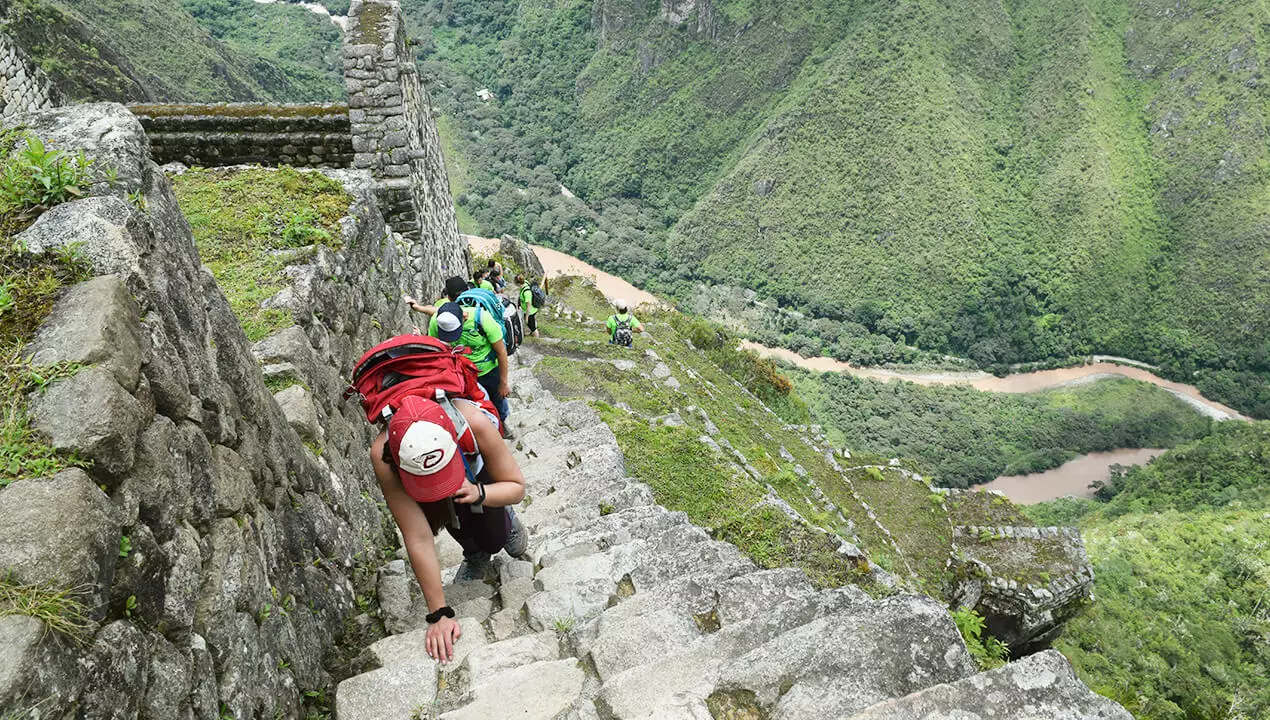
On paper, Huayna Picchu doesn't sound extreme: round trip it's only about 4 km (2.5 miles) and takes most visitors 2 to 3 hours. What makes it feel harder than the numbers suggest is that almost all of that elevation gain — roughly 300 to 350 meters — comes on steep, uneven, centuries-old stone steps rather than a graded trail. Some sections, informally nicknamed the "Stairs of Death," are close to vertical, narrow, and run directly along drop-offs, with fixed cables bolted into the rock to hold onto through the most exposed stretches. Near the summit, the one-way descent route typically funnels through a tight rock passage — take your day pack off first if you're not travel-light, since it's a genuine squeeze.
None of this requires technical climbing skill or gear — no ropes, harness, or prior experience needed — but it does demand steady footing, a reasonable level of fitness, and comfort with heights. Guides and past visitors consistently rate it "moderate to difficult," and it's genuinely not recommended for anyone with significant vertigo, a fear of exposed heights, unmanaged mobility limitations, or young children (most providers set a minimum age around 12). If in doubt, Circuit 3B — the lower-terrace walk without the mountain — is a better call.
Practical Tips for Hiking Huayna Picchu
A few things make a real difference on the mountain itself:
Go with the earliest slot you can get. Morning entries mean cooler temperatures, softer light for photos, and a better chance the summit is clear before afternoon cloud rolls in over the valley.
Wear real hiking shoes with grip. The stone steps are often polished smooth from centuries of foot traffic and can be slick if damp — trail runners or hiking shoes with good tread matter more here than almost anywhere else in Machu Picchu.
Carry water and sun protection. There's little shade on the ascent, and at this elevation the sun is stronger than it feels. At least one liter of water per person is a sensible minimum.
Pace yourself and use the cables. There's no shame in stopping often — every landing has a view worth pausing for. On the exposed sections, keep a hand on the fixed cables and watch your footing rather than the scenery while you're actually moving.
Travel light. A small day bag is plenty; anything bulky will be awkward at the narrow rock passage near the summit, and porters or large packs generally aren't practical on this trail.
Build in a buffer. You'll need to reach the Huayna Picchu checkpoint within your assigned entry window, and it's a short walk from the main citadel entrance — leave enough time to get there without rushing the lower-terrace portion of Circuit 3A first.
Circuit 3A vs. Circuit 3B
See the sibling route: Circuit 3B. Both share the same lower-terrace ground within Circuit 3 — see the full circuit guide for booking and timing details — but only 3A includes the Huayna Picchu climb.
We'll confirm it for you.
What to Expect on Route 3A
Route 3A starts with Circuit 3's lower-terrace path — mostly level or gently sloped walkways, the easiest walking in the whole complex. But 3A doesn't stop there: it continues onto the Huayna Picchu trail, which is a different experience entirely. Expect steep, narrow stone stairs, some sections with fixed cables for support, and real drop-offs. Round trip, the mountain adds roughly 2 to 3 hours on top of the lower-terrace walk.
Because of that climb, Route 3A is not the comfortable, low-effort option some travelers assume it is. It's a better fit for reasonably fit visitors who specifically want the summit views than for families with young children or anyone managing mobility limitations — those travelers are generally better served by Route 3B.
Who Route 3A Suits Best
Route 3A suits travelers who want the classic postcard view down onto Machu Picchu from above and are willing to put in the effort to get it. It's a demanding add-on, not a gentle stroll, so it's worth being honestly fit and comfortable with heights before booking it. Because Huayna Picchu access is normally limited and sold in advance, it's also worth confirming availability early rather than assuming it can be added at the last minute.
If you've only just arrived in the region and haven't acclimatized to altitude, be cautious: the extra exertion on Huayna Picchu can make altitude symptoms noticeably worse than the light lower-terrace walk alone would.
What Route 3A Actually Covers
Route 3A covers the same lower-terrace viewpoint sequence as Circuit 3B — generally moving through the agricultural terraces on the lower slopes before passing near the main structures — and that portion stays gentle in terrain throughout, with minimal elevation change. Where 3A diverges is the climb up Huayna Picchu that follows, which is steep and physically demanding in a way the lower terraces are not.
Because of that added climb, the difference between Route 3A and 3B has considerably more practical impact than the equivalent 2A/2B sequencing split on Circuit 2 — this isn't a minor reordering, it roughly doubles your time on site and changes who the route is realistically suited for.
Who This Sub-Route Suits
Travelers on Route 3A are typically those who have specifically booked (or requested) the Huayna Picchu add-on, since spots are limited and released in advance. If you're visiting with family members who have mobility limitations, or you simply want the lightest possible visit, Route 3B delivers the easier lower-terrace experience without the mountain climb.
Circuit 3A is the Huayna Picchu-inclusive sequencing within Circuit 3. See the full Circuit 3 guide, or compare with the easier Circuit 3B.
Questions about your ticket or the Huayna Picchu add-on? Get in touch with our team.