
Short answer: yes, for a prepared trekker on a licensed operator, the Inca Trail is safe by the standards of any serious multi-day high-altitude trek. It is also not risk-free, and the guides who tell you otherwise are not doing you a favour. What follows is the same conversation we have with clients who ask us this exact question every week — where the real risks actually sit, what a well-run operation does to manage them, and what you can do yourself, before you ever set foot on the trail, to stack the odds firmly in your favour. No exaggeration in either direction: not a marketing brochure, not a scare piece.
Why This Question Deserves a Direct Answer
Every year we get a version of the same message from a prospective client: a friend, a forum thread, or an old travel documentary planted a worry about the Inca Trail that isn't quite grounded in how the trail actually operates today. That's understandable — before 2002, the route genuinely was a different, far less controlled experience, with as many as 1,600 people a day walking an unregulated corridor and no meaningful oversight of guides, porters or trail conditions. That version of the Inca Trail no longer exists. What exists now is one of the most tightly regulated multi-day treks anywhere in the world, run through a government permit system, capped access, mandatory licensed guides and ranger checkpoints at both ends.
That doesn't mean the trail is risk-free — no high-altitude, multi-day trek is. What it means is that the risks are known, largely predictable, and mostly manageable with the right preparation and the right operator. The rest of this guide walks through exactly what those risks are, honestly, rather than either dismissing them or inflating them for dramatic effect.
The Permit System Is Itself a Safety Mechanism
It's easy to think of the 500-person daily cap as purely an environmental protection measure, and it is that — but it is also a direct safety control. A capped, licensed system means every group on the trail on any given day is accounted for: names, passport numbers and dates are registered with SERNANP (Peru's National Service of Natural Protected Areas), checked at the Km 82 and Km 104 checkpoints, and tracked through to arrival at the Sun Gate. Independent, unguided hiking is not permitted under any circumstance — anyone attempting it is turned back at the checkpoint. That single rule removes the single largest risk factor present on unregulated treks anywhere in the world: solo travellers going missing on unmonitored terrain.
Every licensed operator is legally required to provide a guide certified through Peru's Ministry of Tourism, trained in first aid, altitude-related emergency response and cultural interpretation. The legal minimum is one guide per 16 trekkers, though the better operators — Kontiki Hikes included — run closer to 1:8, which matters considerably more in an actual emergency than it does on an ordinary day. Guide credentials are checked at every checkpoint; an unlicensed or uncertified guide is removed from the trail on the spot, with the operator facing penalties that can include losing their permit allocation entirely.
The practical upshot: the Inca Trail is not a wilderness route where you're relying on your own judgement in an emergency. It is a monitored corridor with a legally mandated, trained professional walking with you the entire way, and a registered emergency contact chain behind every group.

The Real Risk: Altitude, Not Adventure
If something goes wrong on the Inca Trail, altitude is almost always the underlying cause — directly through acute mountain sickness, or indirectly through the exhaustion and poor decision-making that low blood oxygen produces. Day 2 is the day that matters most: trekkers climb from around 3,000m at camp to Dead Woman's Pass at 4,215m, the highest point on the route, before descending steeply to the Pacaymayo campsite. This is the single hardest physical day of the trek and the point where altitude symptoms — headache, nausea, dizziness, shortness of breath — are most likely to appear, even in trekkers who felt completely fine in Cusco.
This is precisely why we build two to three full acclimatisation days in Cusco (3,400m) into every itinerary before the trek begins, rather than treating it as an optional add-on. A body that has had time to adjust its red blood cell production and breathing rate handles Dead Woman's Pass in a fundamentally different way than one arriving straight from sea level. Guides carry pulse oximeters and check oxygen saturation at camp each evening — not as theatre, but because it's the earliest and most reliable warning sign of a developing problem, often before the trekker themselves feels unwell.
Terrain and Weather — Where Falls Actually Happen
The Inca Trail is a genuine stone path, much of it original 15th-century construction, and it was not built with modern hiking boots or handrails in mind. The steep, uneven stone staircase immediately after Dead Woman's Pass — nicknamed by more than one guide as the trail's true test of the trip — is where the majority of minor injuries occur: twisted ankles, jarred knees, the occasional stumble on a step worn smooth by six centuries of foot traffic. None of this is exotic risk; it's the same risk profile as any steep alpine stone trail anywhere, and trekking poles make a measurable difference here.
Weather adds a variable most first-time trekkers underestimate. The dry season (May to September) is genuinely dry during the day but drops to near-freezing at exposed high camps overnight — cold-related discomfort, not danger, for a properly equipped trekker, but a real problem for someone without a rated sleeping bag. The wet season (November to March) brings the more relevant safety consideration: the same stone steps that are simply steep in dry conditions become genuinely slippery when wet, and this is when the rate of minor falls rises noticeably. SERNANP and the Ministry of Culture can and do close sections of the trail temporarily in response to landslides or unusually heavy rain — a licensed operator is legally responsible for offering an alternative date or route if this affects your booking.
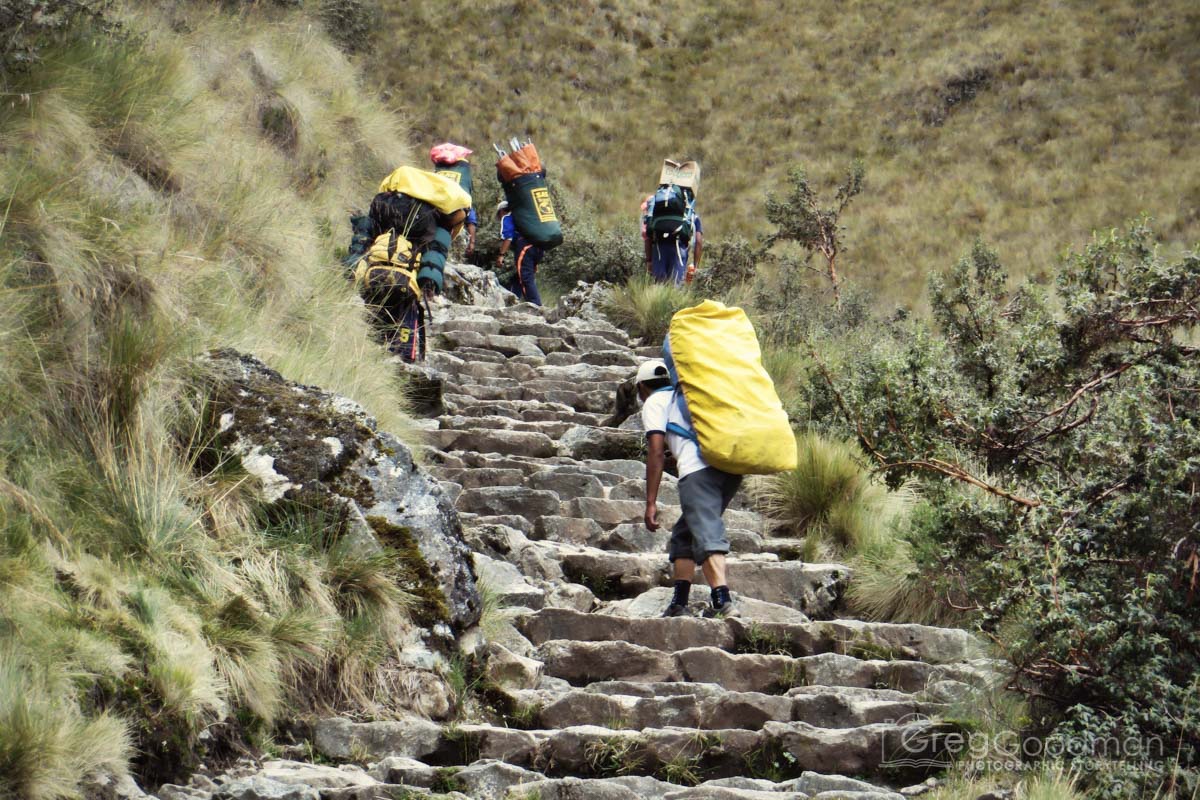
Porter Welfare — A Safety Indicator, Not a Side Issue
Peruvian regulation caps porter loads at 20kg (8kg personal gear plus 12kg of group equipment), mandates rest breaks, adequate food, proper tents, and requires operators to carry accident insurance for every porter on the trail. These rules exist because, before regulation tightened, porter overloading and inadequate cold-weather equipment were a genuine and serious problem on the trail — and in some corners of the industry, enforcement gaps still exist.
We treat this as directly relevant to trekker safety, not a separate ethical footnote. An operator willing to quietly exceed legal porter loads to cut costs, or skip proper cold-weather gear for its crew, is very often the same operator making equivalent compromises on trekker-facing safety margins — fewer guides per group, cheaper insurance, less rigorous first-aid kits. Porter treatment is one of the most reliable proxy signals available to a traveller trying to judge an operator's overall standards before booking, and it's a completely reasonable question to ask directly.
Crime and Theft — The Smallest Risk on This List
Because the trail corridor is permit-controlled and checkpoint-monitored, it is not an environment where strangers can simply wander in — which meaningfully limits the kind of opportunistic crime that can affect open, unregulated trekking routes elsewhere. The realistic risk on the Inca Trail is petty theft at camp: an unattended phone, camera or cash left outside a tent overnight. It is not common, but it happens, and the better operators actively mitigate it — staff posted near communal gear, clear briefings on keeping valuables inside your tent, and dining tents that stay attended. Ask any operator how they handle camp security; a specific, practiced answer is a good sign.
Inca Trail vs Alternative Machu Picchu Routes — Safety Profile Compared
If safety concerns are part of what's making you hesitate on the Classic Inca Trail specifically, it's worth knowing how it actually compares to the main alternatives — because the answer isn't always what people assume.
| Route | Highest point | Regulated / permit-capped | Guide required by law | Main risk factor | Evacuation access |
|---|---|---|---|---|---|
| Classic Inca Trail (4D) | 4,215m | Yes — 500/day cap | Yes | Altitude, wet-season steps | Horse / stretcher, no road |
| Short Inca Trail (2D) | ~2,700m (Km 104 start) | Yes — 250/day cap | Yes | Minor — lower altitude exposure | Horse / stretcher, short distance |
| Salkantay Trek | 4,630m | No permit required | Recommended, not legally mandated | Higher altitude exposure than Inca Trail | Road access at several points |
| Lares Trek | ~4,450m | No permit required | Recommended, not legally mandated | Remoteness, fewer other trekkers nearby | Limited, rural road access |
| Train to Machu Picchu | 2,430m (Aguas Calientes) | N/A | Optional | Lowest overall physical risk | Full rail and road access |
The counter-intuitive finding here: the Classic Inca Trail is not the highest-altitude or least-regulated option — the Salkantay and Lares treks both reach higher altitudes with no permit system and no legal guide requirement, and evacuation access on the Inca Trail, while lacking a road, benefits from a shorter, better-known corridor with an established rescue protocol. For trekkers specifically weighing safety, the Classic Inca Trail's tight regulation is, on balance, an advantage rather than a limitation.
What To Actually Check Before You Book
After years of fielding this exact question, here is the distilled version of what separates a genuinely safe operation from one that just looks like one on a website.
Confirm the licence, not just the claim
Every legitimate operator holds a current MINCETUR licence and SERNANP-issued permits tied to your specific dates. Ask for the operator's registration number and, if in doubt, verify it directly with Peru's Ministry of Culture. Prices significantly below the $600–$900 range for a standard 4-day departure are one of the more reliable red flags for an operation cutting corners somewhere — most often on porter treatment, guide ratios or insurance.
Ask about guide-to-trekker ratio, not just guide certification
The legal minimum is one certified guide per 16 trekkers. In an actual emergency, that ratio determines how much individual attention is available. Operators running 1:8 or tighter are making a genuine safety investment, not just a marketing claim.
Confirm supplemental oxygen and first-aid kit contents
A reputable operator carries oxygen, a pulse oximeter and a first-aid kit stocked for altitude-specific emergencies, not just blister plasters. This is a fair, specific question to ask before booking — and the quality of the answer tells you a great deal about the operation.
Require travel insurance with high-altitude evacuation coverage
This is the document that matters most if something does go seriously wrong. Confirm your policy explicitly covers trekking above 4,000m and emergency evacuation — not just general medical treatment. Reputable operators will ask to see proof of this before your departure date; treat an operator that doesn't ask as a mild warning sign.
Don't skip acclimatisation days to save an itinerary day
The single most common preventable mistake we see is trekkers arriving in Cusco and starting the trail within 24–48 hours to save time. Two to three acclimatisation days beforehand is the highest-leverage safety decision within your own control — more so than fitness level, gear, or even operator choice. Read our full Cusco altitude sickness guide for the complete protocol.

properly acclimatised.

